How to Declutter Kids' Toys Without Tears—or Arbitrary Toy Limits
You can declutter toys without a magic number. Instead of counting, remove what is unsafe, broken or incomplete, group the rest by type, keep accessible only what fits the space and what your child actually plays with, and store or rotate the remainder. This guide shows you how, including how to involve your child, handle gifts and stop the cleared space filling up again.
If your whole home feels overwhelming, begin with how to start decluttering. If you are preparing for holiday gifts, use this alongside the pre-holiday decluttering checklist.
Why Toy Counts Do Not Work
Parenting blogs often suggest a fixed number of toys, such as "twenty toys per child." Those numbers are practical suggestions from individual writers, not scientifically established limits, and they ignore real differences between households. Toys vary in size and in pieces: a box of building blocks and a doll count equally in a headcount but take different space and serve different play. A family in a small flat and a family with a dedicated playroom face different constraints.
A more reliable approach is to let four things set the limit: safety and condition, completeness, how the toy is actually used, and the space you have to store it. That is the system below.
Step 1: Decide What the Play Space Must Hold
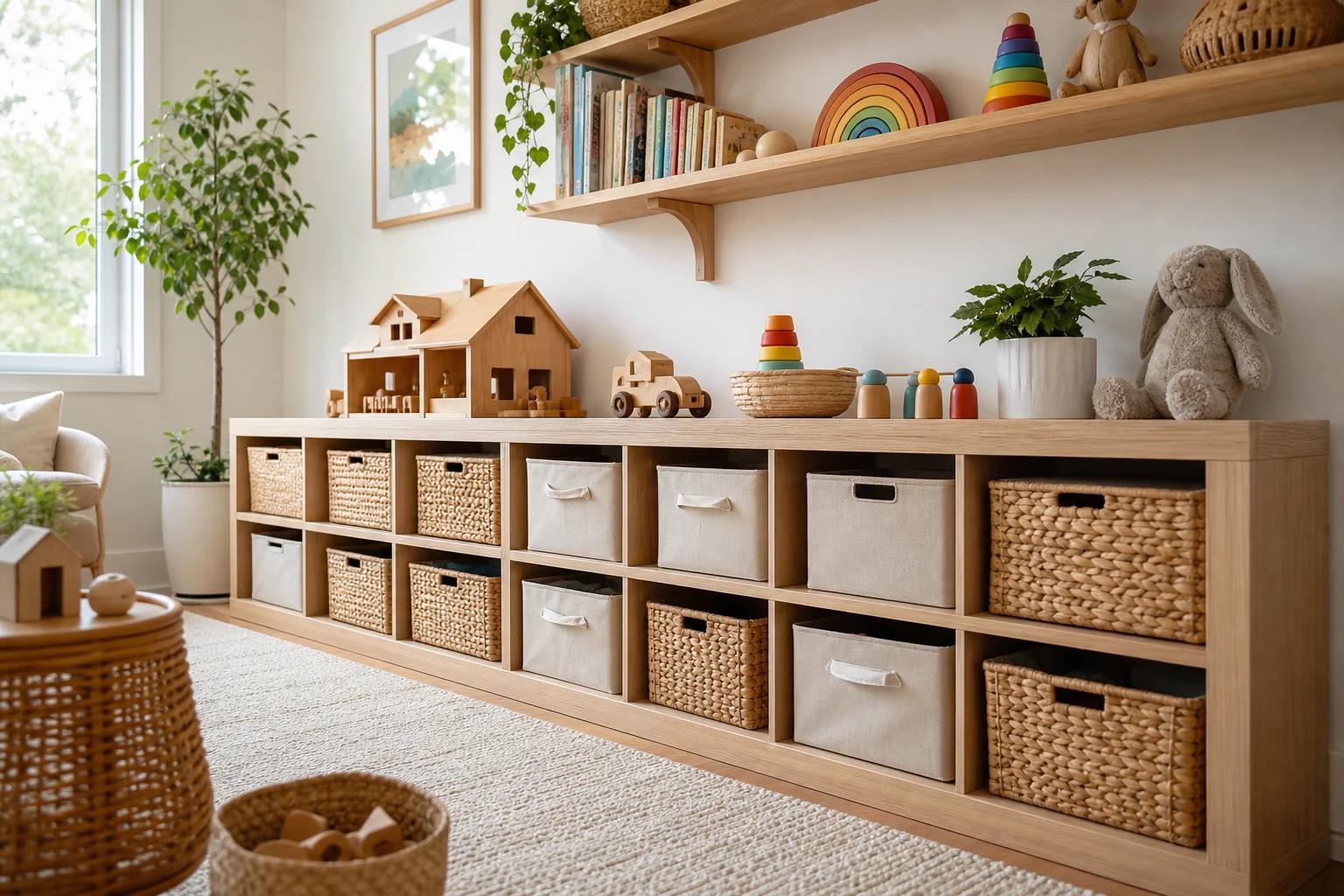
Pick the area where toys will live and note its size: a shelf unit, two bins, a corner or a whole room. Whatever fits comfortably there, with room to find and put things back, is your starting limit. If you are short on space generally, our small apartment decluttering guide offers ways to make the most of limited room.
Step 2: Remove Unsafe, Broken and Incomplete Toys First
This step is not a matter of taste, so it needs no negotiation with your child. Work through the pile and set aside:
- Recalled or potentially hazardous toys. In the United States, check the CPSC recall list; other countries have their own official recall databases. Do not give away or sell a recalled toy. Follow the recall instructions.
- Broken toys that cannot be repaired quickly, and items with sharp edges, cracks or loose parts.
- Incomplete sets where missing pieces make the toy unusable, such as puzzles or board games without all their pieces.
- Toys with batteries that have stopped working. Remove batteries if you can and take them to a battery recycling point rather than trash, as local rules may prohibit trash disposal.
The CPSC states that people who give away used products cannot donate products that do not meet legal requirements, and that recalled products can end up in thrift stores. That is a reason to check before you donate, not after. For where each item goes, see our guide to selling, donating, recycling or trashing decluttered items.
Step 3: Sort the Rest by Type
Group what remains into categories: building toys, dolls and figures, vehicles, art supplies, books, games and puzzles, pretend play, and baby toys. Seeing all the cars in one place, or all the stuffed animals together, makes duplicates and gaps obvious. It also makes it easier to ask your child questions, such as "Which of these do you play with most?"
Step 4: Decide What Stays Accessible
For each category, apply two tests:
- Use: Has your child played with it recently, or is it a favorite you know has returned in cycles?
- Fit: Does it fit in the space you set aside in step 1 without overflowing?
Toys that pass both tests go in the main play space. Toys that pass the use test but not the fit test go to storage for rotation. Toys that are outgrown, unused and not especially meaningful are candidates for donation.
Example: A five-year-old has six bins of building blocks, a shelf of puzzles and a large pile of small figures. The play shelf holds three bins. She chooses her favorite block set and the figures she uses in pretend play; the rest of the blocks go in a storage box for later, and incomplete puzzles go in the recycling or trash.
Step 5: Involve Your Child Appropriately
Children can contribute, but they should not be responsible for all decisions. These are practical suggestions rather than established rules, and they need adjusting for age and temperament.
- Adults decide: safety, broken items and overall space limits.
- Children choose: which favorites stay out, and which toys go in a "someone else would like this" box.
- Younger children: offer two or three categories to decide between instead of showing them everything at once.
- Keep sessions short. Stopping before they are tired avoids tears and preserves goodwill.
If your child is upset about a particular toy, set it aside in a "not yet" box with a size limit and a review date, rather than forcing a decision.
Step 6: Set Up Toy Rotation
Rotation means keeping some toys out of sight and swapping them in periodically. Many organizing writers recommend it for reducing the number of toys in view at once. The evidence for any specific schedule is anecdotal, so treat it as an experiment: store a box or bin, wait a few weeks, and swap it for the current selection. Watch whether your child asks for stored items; if they never do, they are likely donation candidates. Use clear, shallow bins or labelled boxes so toys are easy to find and put away.
Step 7: Handle Gifts Before They Arrive
Gifts are the main route by which toy clutter returns. You can reduce the flow without confrontation.
- Before birthdays and holidays, tell relatives what would be welcome (experiences, books, consumables, or one larger gift) and what would be hard to fit.
- Make space ahead of time by clearing a spot for new toys, so you can easily see what you already have.
- For new toys, consider a one-in, one-out approach for similar categories as a flexible habit rather than a rule.
- Let toys age out: after a few weeks, pass on the gifts your child ignored.
Step 8: Donate Responsibly
Donate only clean, complete, working toys that pass a recall check. Acceptance policies differ among charities, shelters, schools and thrift stores, and some do not accept certain items such as stuffed animals or used car seats, so ask before you drop off. Remove the batteries from electronic toys if you can, and keep any original instructions or small parts together in a bag.
Preventing the Refill
Cleared space invites more stuff. These habits help keep it clear:
- Treat the shelf or bin as the limit. When it is full, something leaves or goes to storage before something new comes in.
- Check the storage box before you buy. You may already have what your child wants.
- Do a five-minute weekly reset to put toys back in their category bins and spot broken pieces.
A Four-Week Pre-Birthday or Pre-Holiday Reset
- Week 4: Do the safety, broken and incomplete sweep. Check recall lists.
- Week 3: Sort by category and choose what stays accessible.
- Week 2: Donate outgrown items and set up the storage box.
- Week 1: Share gift suggestions with family and clear a spot for new toys.
Common Mistakes
- Following a toy count that does not fit your home.
- Throwing out toys in secret. It can damage trust and leave children anxious.
- Buying storage before sorting.
- Donating broken or recalled items.
- Keeping every stored toy forever without a review.
Toy Declutter Checklist
- Play space size set
- Recalls checked; unsafe, broken and incomplete toys removed
- Toys grouped by type
- Use and fit tests applied to each category
- Child chooses favorites and a donation box
- Storage box for rotation labelled and dated
- Donations clean, complete and scheduled for drop-off
- Gift plan shared with family
Your Next Step
Set a timer for 20 minutes and do step 2 only: remove anything broken, incomplete or potentially recalled. You will already see more floor and a shorter pile to sort.
Frequently Asked Questions
How many toys should a child have?
There is no scientifically established universal number. Use the space available, condition and safety, and what your child actually plays with to set limits that suit your home.
Should I declutter toys without telling my child?
It is usually better to involve them in age-appropriate ways. You can handle safety and broken items yourself, and let them choose favorites and a donation box.
Can I donate used toys?
Yes, if they are clean, complete and working, and not recalled or hazardous. Check the charity's policy first, as acceptance varies.
How do I check whether a toy has been recalled?
In the United States, use the CPSC's recall list. Other countries have their own official product safety recall websites; check yours before donating or selling.