Why Clutter Keeps Coming Back—and How to Stop It
If clutter keeps returning, the issue is usually maintenance, not motivation. Fix the system around the clutter and the room gets easier to keep up.

If clutter keeps coming back after you declutter, the problem usually is not that you failed to tidy properly. The problem is that the systems around the clutter did not change. Decluttering removes excess items that are already in the house. Maintenance controls what comes in, where things land, how action items are handled and how outgoing items actually leave.
This matters because many people do a successful weekend clear-out, feel relief for a few days and then slowly watch the same surfaces refill. That pattern is frustrating, but it is also useful. It tells you the clutter has a source. Once you identify that source, you can choose a maintenance system that fits the way your home actually works.
The difference between decluttering and maintenance
Decluttering is a reduction project. Maintenance is a flow system. One removes extra inventory. The other stops fresh clutter from rebuilding in your kitchen, bedroom, hallway, office or laundry area. If you only do the first part, your home may look better for a while but drift back toward the same pressure points.
A practical way to think about this is simple: every item in your home is either arriving, being used, waiting for action, being stored or leaving. If clutter keeps returning, one of those stages is broken.
The seven most common reasons clutter returns
1. Too much is still coming in
You may be decluttering regularly but still buying, accepting or saving things faster than they leave. This often happens with clothes, toiletries, mugs, storage containers, children's items, hobby supplies and free promotional items. If inflow stays high, the home gradually refills even after a strong clear-out.
2. Items do not have a real home
When something has no assigned place, it lands wherever there is room. That is how counters, chairs, stairs and the end of the bed become accidental storage zones.
3. The home exists, but it is inconvenient
Sometimes people technically have a place for an item, but it is annoying to use. The lid is awkward, the shelf is too high, the drawer is jammed, the hook is too far from the door. If putting something away takes too many steps, most people will default to the nearest flat surface.
4. You still own too many items for the space
A drawer, shelf or closet that is always stuffed creates daily friction. Even if every item technically belongs there, the space is too full to reset easily. In those cases, the answer is not usually another organizer. It is less inventory.
5. You have action clutter
Action clutter includes things that require a next step: returns, forms to sign, gifts to deliver, repairs, batteries to recycle, clothes to alter and items waiting to be sold. They are not random. They are delayed tasks in object form. Without a system, they spread across visible surfaces.
6. Outgoing items stall
Donation bags, resale piles and recycling boxes often become clutter themselves. They feel like progress, but if they stay in the house for too long, they still consume space and visual attention.
7. There is no reset rhythm
Even well-organized homes need short resets. School papers arrive, laundry builds up, groceries need putting away and daily life creates drift. A space that never gets a quick reset eventually asks for another large decluttering session.
How to diagnose your pattern
Pick one hotspot that keeps filling up. Common examples include the kitchen counter, dining table, hallway bench, bathroom vanity, bedroom chair or home-office corner. Then ask four questions:
- What kinds of items keep appearing here?
- Are they incoming items, things without a home, things waiting for action or things that should already have left?
- Is the current storage inconvenient?
- Is the space simply holding too much?
Do not try to solve the entire home at once. Diagnosing one hotspot clearly is more useful than naming ten vague frustrations.
Fix the incoming flow
If a category keeps expanding, give it a limit. For many households, one-in, one-out can help with categories that multiply easily, such as clothes, mugs, books or toys. The key is to use it selectively where it solves a real problem, not as a rigid rule for every item in the home.
You can also add a pause before new items enter the house. Ask: where will this live, what will it replace, and do I already own something that does the same job? This short pause catches many unnecessary additions before they become future decluttering work.
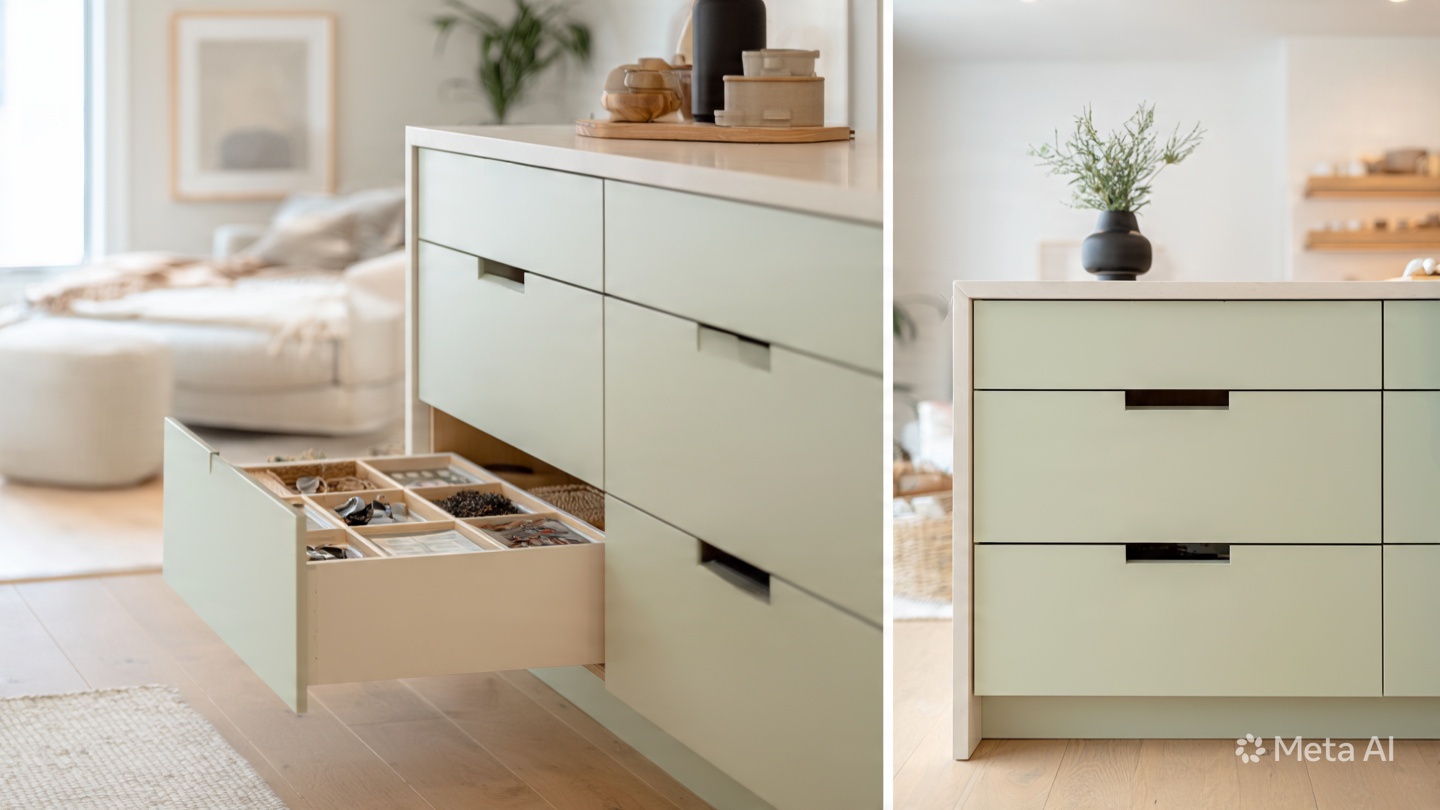
Give things a home near where they are used
Items are more likely to be put away if their storage location matches their real-life use. Keys need to live near the door, not in a deep drawer across the house. Reusable shopping bags need to be where you leave for the car. Hair tools need a simple, heat-safe place near where they are used. The easier a home is to reach, the more likely it will be used consistently.
If a space repeatedly becomes a drop zone, that is a clue. Instead of blaming yourself, redesign the storage so it cooperates with the way the room already behaves.
Use the container as the boundary
A shelf, drawer, basket or bin can act as a natural limit. When the container is full, the category is full. If you want to add something, something else must leave or the new item does not come in. This is easier to maintain than counting exact numbers of items, and it ties the size of the category to the reality of your home.
Create one place for action clutter
Action items need a holding area with review dates. Use one tray for paper that needs attention, one bag or box for returns, one container for repairs and one place for items that are leaving the home soon. Keeping these categories separate prevents them from spreading across every visible surface.
The important part is not the container itself. It is the next step. A returns bag only works if you schedule when the return will happen. A paperwork tray only helps if it gets emptied regularly.
Make outgoing items leave on schedule
Choose a simple rule. For example, donations leave every Saturday, recycling goes out every Thursday, and items you intended to sell get a fixed listing deadline. If the item is not listed or sold by that date, move it through the next best exit route instead of storing the decision indefinitely.
This one change often creates a surprising amount of relief because it closes the loop. Homes stay lighter when removed items actually depart.
Build a realistic reset habit
A reset should be short enough to repeat. Many households do well with five to ten minutes a day in the busiest zone and a slightly longer weekly reset for hotspots. Others prefer a few short resets each week. There is no perfect universal rhythm. The right rhythm is the one your household can keep without resentment.
A good reset is not a deep clean. It is a return-to-home check. Stray items go back, paper gets reviewed, action clutter gets moved forward and obvious excess gets removed before it spreads.
What to do when your family creates clutter differently from you
Shared homes need shared systems. If one person loves baskets and another ignores them, the system has to be adjusted, not just explained again. Use visible hooks instead of closed storage, open trays instead of stacked paper piles, or one container per person in shared areas. Simpler systems tend to survive real life better than clever ones.
What maintenance looks like in real rooms
Kitchen counter
If the counter keeps filling, check whether the problem is mail, groceries without a home, appliances that are rarely used, children’s school papers or items waiting to be returned. Each source needs a different fix. One generic “tidy up” routine will not solve them all.
Bedroom chair
A chair covered in clothes often signals either too many in-between garments, no realistic place for reworn items or a wardrobe that is too full. Add one dedicated place for in-between clothes and reduce the volume in the closet if needed.
Entryway
If shoes, bags and papers pile up by the door, add the minimum number of hooks, bins or trays needed for daily use. Keep the solution close to the path people already take.
Common maintenance mistakes
- Buying more containers before reducing volume. Extra storage often hides the problem instead of solving it.
- Creating “temporary” piles with no deadline. Temporary easily becomes permanent.
- Trying to apply a strict rule to every single category. Flexible systems usually last longer.
- Expecting the home to stay perfect. The goal is easy recovery, not constant visual perfection.
- Ignoring incoming clutter. Outflow matters, but inflow often matters more.
A maintenance plan you can start this week
- Today: choose one hotspot and diagnose the source.
- Tomorrow: give the top three repeat offenders a better home.
- This week: schedule one donation or recycling exit.
- This weekend: reduce one overfull category to fit its container.
- Ongoing: run a short reset at a repeatable time.
Clutter usually comes back because the home is missing a maintenance system, not because you lack discipline. Once you identify the source, the fix becomes far more practical.
Frequently Asked Questions
Why does clutter come back so quickly after I declutter?
It often comes back because the underlying system did not change. Common causes include too many new items entering the home, inconvenient storage, stalled outgoing items and no regular reset routine.
Does one-in, one-out solve clutter permanently?
It can help control certain categories, but it is not a complete system on its own. It works best when combined with realistic storage, outgoing routines and limits on overfull categories.
How often should I reset clutter hotspots?
Choose a rhythm you can sustain. Many homes benefit from quick daily or near-daily resets in the busiest areas and a slightly longer weekly check for paper, returns and outgoing items.
What is action clutter?
Action clutter is a group of items that require a next step, such as returns, forms, repairs or donations. It becomes stressful when those objects do not have one holding place and one review date.