Living Room Rescue: How to Reclaim Your Home from Reseller Clutter

Your living room didn't become a staging warehouse overnight. It happened one "I'll deal with that later" at a time — a bin here, a trash bag there, until the couch is the only clear surface left. This guide is your system to take it back, permanently.
The Real Cost of Decluttering Reseller Death Piles in Living Rooms
The word "death pile" has gone mainstream in reseller communities on r/Flipping and r/Poshmark — it's the unlisted inventory that has stopped being an asset and started being an anchor. When that pile migrates into your living room, the costs compound fast: partners report tension over shared spaces, sellers avoid video calls out of embarrassment, and items get lost in common areas, costing real money in missing listings and missed sales.
Before we talk containers and zones, let's name the actual problem: your home has two competing functions — a business workspace and a rest and life space — and right now the business is winning by default. The fix isn't to work less. It's to draw hard borders, and then hold them.
"The pile isn't a character flaw. It's a missing system. You don't need motivation — you need a container and a rule."
— Clara Bennett, declutterrules.org
Zone Assignment: The Non-Negotiable First Step
Zone assignment means physically designating which square footage belongs to your business and which belongs to your life — and never letting those categories bleed into each other. This is not an aesthetic exercise. This has tax implications (more on that below) and relationship implications. Draw it on a floor plan sketch if you need to make it real.
The Three Zones of a Reseller Home
- Work Zone — Inventory intake, photography, packing, and storage. This area is business-only. Nothing "lives" here that isn't part of an active listing workflow.
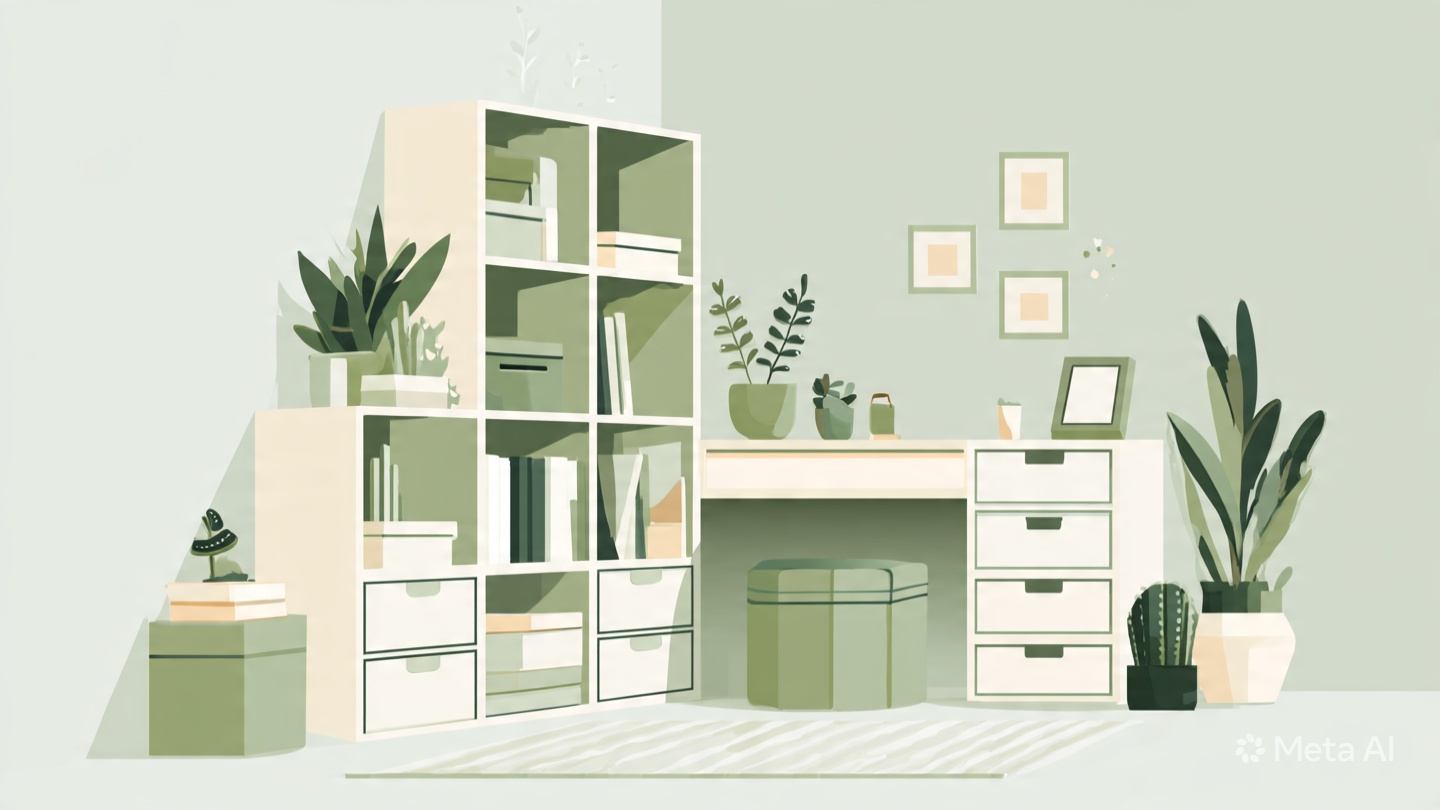
- Transition Zone — A single, contained staging area (one shelf unit or a rolling cart) where new acquisitions land before they are triaged. This zone has a hard capacity limit. When it's full, you stop sourcing until it clears.
- Life Zone — The rest of your home. Couch, coffee table, dining table, and bedroom are permanently off-limits to inventory. No exceptions. No "just for tonight."
The Transition Zone is the one that most resellers skip, and it's why death piles form. Without an intentional intake buffer, every haul goes directly to the floor, the couch, or wherever there's space. Give the chaos one legal home — and make that home small on purpose.
Container-Based Limits: The Rule of Fixed Bins
The most reliable organizational system for resellers is container-based thinking: you do not manage by counting items, you manage by filling containers. When the container is full, the workflow stops until it empties. This is how successful resellers on Reddit's r/Flipping community describe keeping their homes livable — not by discipline, but by physics.
Setting Your Bin Maximum
- Part-time sellers (1–3 hours/day): Maximum 3 standard bins in the Work Zone at any one time.
- Full-time sellers: Maximum 6–8 bins, but stored on dedicated shelving — never on floors in life areas.
- Every bin gets a label category: Intake / Photography Queue / Listed–Awaiting Sale / Ready to Ship. Items only move forward, never backward.
- The Photography Queue is capped at 1 bin. If it overflows, your next task is listing, not sourcing.
Label your bins with masking tape and a Sharpie. You do not need a beautiful system — you need a consistent one. A $3 bin with a legible label beats a $40 aesthetic storage box that never gets sorted.
The "Move It or List It" Tally
Every item in your current death pile needs a verdict within 48 hours of you picking it up. No more indefinite holding. Use this simple tally to work through the pile in one focused session — set a timer for 90 minutes and process until the timer ends.
| Question | Answer | Action | Tally |
|---|---|---|---|
| Do I know the platform and price point for this item? | Yes | LIST IT — goes into Photography Queue bin | |||| |||| |
| Do I know the platform and price point for this item? | No | RESEARCH IT — spend max 5 min on eBay sold listings. Still unsure? Move it. | |||| |
| Has this item been in my possession for more than 90 days unlisted? | Yes | MOVE IT — donate, bundle, or sell in a lot | ||| |
| Would I be embarrassed if a client saw this on a video call behind me? | Yes | MOVE IT TO WORK ZONE immediately — not the couch | || |
| Is this item damaged and requires repair before listing? | Yes + repair is realistic | REPAIR BIN — capped at 5 items max. No bin? Move it. | | |
Print this tally, grab a marker, and physically touch every item. The act of physically handling each piece — not just scanning the pile visually — is what forces a decision. Do not skip items. Every item gets a tally mark before the session ends.
[PRINTABLE_DOWNLOAD_BOX]Separating Work and Rest: Protecting Your Off-Hours
One of the most-cited tensions in reseller households — reported consistently in r/Poshmark discussions — is that inventory in shared spaces makes partners feel like they live in the business, not just near it. The fix is visual: when you're done working, there should be zero evidence of your business in the Life Zone.
The "End of Day" Protocol
- All items in progress go back into their assigned bin before leaving the Work Zone.
- Bins are stored out of sightlines from the couch or dining table — behind a curtain, inside a closet, or in a dedicated room if you have one.
- Photography backdrops and lighting equipment fold and store in under 3 minutes. If setup takes longer than that, simplify your rig.
- Shipping supplies (tape gun, poly mailers, boxes) live in one rolling cart that can be wheeled out of sight. This is your Work Cart — treat it like office furniture that goes away at 6 PM.
The goal isn't a perfect, Instagrammable home. The goal is that your partner can sit on the couch without moving a bin, and you can join a video call without apologizing for what's behind you. That's a solvable, systems problem — not a space problem.
Square Footage Documentation for the Home-Office Tax Deduction
Here is where your zone assignment pays dividends beyond sanity: the IRS allows resellers and self-employed individuals to deduct the portion of their home used regularly and exclusively for business. Documenting your Work Zone square footage is therefore not optional — it is money.
Two Methods — Pick One Per Tax Year
- Simplified Method: Multiply your dedicated Work Zone square footage by $5 per sq ft (IRS rate). Maximum deductible area is 300 sq ft, so the maximum deduction via this method is $1,500. No depreciation complications. Clean and easy.
- Regular Method: Divide Work Zone sq ft by total home sq ft to get your "business use percentage." Apply that percentage to actual home expenses (mortgage interest, rent, utilities, insurance). More work, but higher deductions for larger homes with meaningful overhead costs.
How to Document Your Space (Do This Now)
- Measure and record: Use a tape measure. Write down length × width of every room or area used exclusively for your reselling business. Note the date.
- Photograph the space: Take dated photos of your Work Zone showing its dedicated business use — shelving, bins, photography setup. This is your audit defense file.
- The "exclusive use" rule is strict: If your Work Zone is a corner of a room where you also watch TV, it does not qualify. The zone must be business-only. This is why your zone assignment from Step 1 matters legally, not just logistically.
- Track monthly: The IRS requires a minimum of 15 days of qualified business use per month to count that month in your calculation. Keep a simple log.
- Store space includes your inventory storage bins. Dedicated shelving used exclusively for inventory storage counts toward your deductible square footage — this is often the largest area in a home-based reselling operation.
Quick Calculation Example
- Work Zone: 10 ft × 12 ft = 120 sq ft
- Simplified Method deduction: 120 × $5 = $600 per year
- Total home: 1,200 sq ft → Business use %: 10%
- Annual rent: $18,000 → Regular Method deduction: $1,800
- In this example, the Regular Method wins by $1,200. Run both calculations before filing.
This is a general educational example. Consult a tax professional for advice specific to your situation. IRS Publication 587 covers home office deductions in full.
The System at a Glance
- Step 1 — Zone: Assign Work, Transition, and Life zones. Sketch them. Make them real.
- Step 2 — Limit: Set your bin maximum. Post the number on the wall. When bins are full, listing comes before sourcing.
- Step 3 — Triage: Run the "Move It or List It" tally on your existing death pile in a single 90-minute session.
- Step 4 — Separate: Implement the End of Day protocol. Work Zone is invisible from Life Zone by 6 PM.
- Step 5 — Document: Measure your Work Zone today. Photograph it. Start a monthly log. This is your tax deduction evidence file.